The trip to Masuku Lodge. February 7th
Our treat for Jan/Feb was planned a while ago. We had hoped to go to Masuku Lodge for the New Year but Sue and Bill Somerset, who run the lodge, were in the UK when we tried to book. That was when we had such an amazing time at Tongabezi instead!
Masuku Lodge is north of the Monze-Livingstone road on a farm in the Nkanga River Conservation area; the turn off from the main road for the lodge is 20 kilometres north of Choma, which is about an hour and a half from Monze. There are a group of farms run by white Zambians who have developed the conservation area, which is especially good for birds in the wet season, the 4th best area in Zambia. A dam they built has created a small lake

which is overlooked by 5 thatched Rondavels.
We set off from Monze, after working on the Friday morning, to catch our now very familiar Mazhandu Family Bus. Sadly a non-executive, five seats across bus, so rather cramped, but when it’s all in the line of pleasure we aren’t too bothered. We were being met in Choma by Bill Somerset who was then giving us a lift to the Lodge. Bill was also meeting his son-in-law Tom who had come from Pretoria via Livingstone to join his wife for the weekend. Tom picked us up while Bill was finishing the shopping so our heavy book laden bag joined the crate of beer and other supplies (plus obligatory Zambian employee) in the back. Bill is an ex-diplomat (1st secretary at Embassies) who has over the last 20+years worked all over the world including Zambia, Ghana, Moscow and Eastern Europe. He retired early and couldn’t stand the idea of the “restrictions and weather in England” so looked elsewhere to live. He and his wife had fallen in love with Zambia and had lots of friends from their time in Lusaka so they decided to retire here. The Zambian Government would only allow this if there were some financial investment hence Masuku Lodge. As he only had the land on a long lease all that he has done in the way of buildings, fencing and road building will eventually go back to the owner of the land. However the main house only cost £15,000 in materials and labour is very cheap. He made all the bricks in his own self-built kiln from one large anthill on the farm.
We set off from Monze, after working on the Friday morning, to catch our now very familiar Mazhandu Family Bus. Sadly a non-executive, five seats across bus, so rather cramped, but when it’s all in the line of pleasure we aren’t too bothered. We were being met in Choma by Bill Somerset who was then giving us a lift to the Lodge. Bill was also meeting his son-in-law Tom who had come from Pretoria via Livingstone to join his wife for the weekend. Tom picked us up while Bill was finishing the shopping so our heavy book laden bag joined the crate of beer and other supplies (plus obligatory Zambian employee) in the back. Bill is an ex-diplomat (1st secretary at Embassies) who has over the last 20+years worked all over the world including Zambia, Ghana, Moscow and Eastern Europe. He retired early and couldn’t stand the idea of the “restrictions and weather in England” so looked elsewhere to live. He and his wife had fallen in love with Zambia and had lots of friends from their time in Lusaka so they decided to retire here. The Zambian Government would only allow this if there were some financial investment hence Masuku Lodge. As he only had the land on a long lease all that he has done in the way of buildings, fencing and road building will eventually go back to the owner of the land. However the main house only cost £15,000 in materials and labour is very cheap. He made all the bricks in his own self-built kiln from one large anthill on the farm.

As the ground around the lodge is sand based and flat, making roads is often only a matter of choosing the routes over the highest ridges to avoid the flooding in the wet season , clearing them of bush and driving on them. The roofs are all thatched using straw from the surrounding area. It all looks great and would fit into any holiday resort in the west.
Bill’s background from a secondary modern state school in Derbyshire, getting A levels after leaving school and while working, isn’t what one would normally expect of the criteria to get into the foreign office, and he hasn’t lost his accent.
Tom, we learnt, married to Karen, Bill and Sue’s younger daughter had worked for the UN in Lusaka, and now, after a period of unemployment had a posting with them in Pretoria. We also learned that we would be joined by Laurie and Kevin; she works for the Canadian Embassy, and also Carolyn Davidson and Tom, who are job sharing as the British High Commissioners which is what ambassadors are called in commonwealth countries. It all seemed set to be a stimulating weekend. The only down side was that it was to be diluted by six young children!
The road from Choma was mainly firm gravel on sand and relatively smooth. The Lodge seemed like a large farmhouse with a straw-thatched roof,


and saw the most remarkable insects,

and butterflies


everywhere and more wild flowers than we have seen before.


The lake has been formed by damming a vlei - stream – to encourage birds and wildlife. Our untrained eyes didn’t see a lot but the lake was beautiful, with white waterlilies that closed as night approached and the skeletons of trees and spectacular sky reflected in the still water.


Early one morning outside our door on our welcome mat where they weren't!


Another use of an umbrella for a two headed cat!
The boys were forbidden to take up our offer of taking them with them!

We now feel it is a little cool if the temperature drops below 27 (80) in the shade, especially if there is a breeze. M feels he has to put a tee shirt when it drops to this level. Today the temperature hit 35oF (54o C) in the sun. We walk home at lunchtime in temperatures of this level and no matter how slowly we walk and under umbrellas it still raises a considerable sweat and it takes at least fifteen minutes to cool after taking most of our clothes off. Arriving back to the hospital after lunch is more of a problem when we have to keep our clothes on!
The horizons here are vast, wide open for miles, broad flat plains of bush with no hills, stretching into infinity and consequently the perspective of the clouds seems quite different from the UK. We can see the clouds approaching as in ranks, or planes landing at Heathrow, regularly, one after another. The flat grey bases follow of the curve of the earth until they reach the horizon. Because of the flat plains and unobstructed views they seem to be ordered in regular rows with only the first in full view the rest partially hidden behind each preceding rank. The straight rows of clouds are just an illusion, as when the clouds arrive they are much more disordered with a lot of irregular broken up blue between the billowing mostly white clouds. The first rank of clouds catch the sun often giving a 3D effect by highlighting their edges as they tower into the blue. I suspect these spectacular skies, which we see every day and are enhanced at sunset and sunrise is because it is the wet season. It difficult to capture the vastness and distance in a photo but here is an attempt
They have a remarkably uplifting effect on us and we never fail to comment on them. It makes our sweaty walks worthwhile. They are so different from the pure blue we saw for the first two months. It does of course also rain a lot and on occasion we have gone two to three days without seeing the sun, but this is unusual. Most of the time it doesn’t rain.
Back to work.
After our amazing trip to Livingstone we returned to basic living and work. I am finding the clinics rewarding and have become better at identifying illnesses such as TB, or Kaposi’s sarcoma. Not something I had a lot of experience of in Fratton. I have also become used to the drug regimes, which are pretty much protocol driven. The whole country uses a standard procedure so in theory gathering data should not be too difficult. The clinic has a lot of frustrations however and could run a lot more smoothly with just a bit more involvement from the nurses and HIV medics (probably less than a specialist nurse). We are constantly running out of the correct sheets for the notes so have to adapt inappropriate ones. Height, weight and pulse observations, which are taken by reception (counsellor, nurse or HIV medic), are at best inaccurate, and at worst seem to be total works of fiction. I have had notes where the height of a patient has varied by as much as five centimetres, over several visits, and in both directions. I would never ask them to check a blood pressure, as it is invariably 120/80.
In spite of all this the clinic does function with little work on 2 afternoons. The patients are all seen albeit there may be long waits for clinicians, counsellors and pharmacy and the drugs always seem to be available. The cost of these anti-retrovirals would be about £400 per month per person in Fratton, which is probably beyond the Zambian economy to sustain.

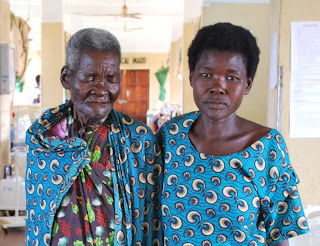
This is a woman and her unmarried son who very successfully run a farm. She is a patient with HIV that we visited at her home. She was widowed probably because her husband died of AIDS when her son was quite small and I suspect she has increasingly relied on him to run the farm.

Dhun and Judy on a wet day visit the home of an HIV patient.

Well it is time to close this. I hope you like the pictures, it takes a long time to load them but it may lighten the long text, which we hope you may find of some interest. It is really a diary for ourselves and the girls but thank you for getting to the end!!


Tom, we learnt, married to Karen, Bill and Sue’s younger daughter had worked for the UN in Lusaka, and now, after a period of unemployment had a posting with them in Pretoria. We also learned that we would be joined by Laurie and Kevin; she works for the Canadian Embassy, and also Carolyn Davidson and Tom, who are job sharing as the British High Commissioners which is what ambassadors are called in commonwealth countries. It all seemed set to be a stimulating weekend. The only down side was that it was to be diluted by six young children!
The road from Choma was mainly firm gravel on sand and relatively smooth. The Lodge seemed like a large farmhouse with a straw-thatched roof,
and our accommodation was in one of the thatched rondavels. There was a superking-size bed with a very large mosquito net that reached to the floor. At home in Monze we have to tuck it in under the mattress. There was a stylish but very simple en-suite and a veranda over looking the bush. The area around the Lodge had quite a park-like feel as it had been cleared and some beautiful flowering shrubs had been planted. We joined the family for tea and cake; it had been Tom’s birthday the day before, and met Sue, Karen and the children – Will almost two years and Ella, eight weeks. It all seemed very familiar!
We then unpacked and relaxed, looking at such a tranquil view, as the sun set. We wandered back to meet the rest of the party for a pre-dinner drink of beer. We had met Carolyn and Tom before at the High Commission reception for our group to celebrate fifty years of VSO. They said that they had remembered us – I said they had been well briefed. In fact we had talked to Tom’s mother predominantly at that event. She had been visiting and it transpired that her brother, a gynaecologist married to a doctor, had gone out to Cambodia as a VSO volunteer (after retirement) in the eighties. They had persuaded VSO that the elderly had something to offer and were pioneers in that area. They continued to go back for many years and in fact we hope to visit them when we come home.
Supper was at a long table in a room not unlike our skiing lodge in Breckenridge with a high gabled ceiling and everything in wood. We sat with Tom and Carolyn and their boys Mark and Matthew (in that order!), Laurie and Kevin and their daughter Alice and son Oliver Tom and Karen and Will (with Ella being breast fed) and Bill and Sue at each end of the table.
We then unpacked and relaxed, looking at such a tranquil view, as the sun set. We wandered back to meet the rest of the party for a pre-dinner drink of beer. We had met Carolyn and Tom before at the High Commission reception for our group to celebrate fifty years of VSO. They said that they had remembered us – I said they had been well briefed. In fact we had talked to Tom’s mother predominantly at that event. She had been visiting and it transpired that her brother, a gynaecologist married to a doctor, had gone out to Cambodia as a VSO volunteer (after retirement) in the eighties. They had persuaded VSO that the elderly had something to offer and were pioneers in that area. They continued to go back for many years and in fact we hope to visit them when we come home.
Supper was at a long table in a room not unlike our skiing lodge in Breckenridge with a high gabled ceiling and everything in wood. We sat with Tom and Carolyn and their boys Mark and Matthew (in that order!), Laurie and Kevin and their daughter Alice and son Oliver Tom and Karen and Will (with Ella being breast fed) and Bill and Sue at each end of the table.
All the children had met before and were very well behaved.
The meal was exceptional with pumpkin soup, beef and fresh vegetables, and the highlight, homemade meringues and guava ice cream all cooked and served by aproned cooks and waiters/waitresses under Sue’s careful supervision. A change from Michael’s usual pudding, yoghurt, banana and syrup!
In spite of the children, who wandered off a lot of the time the conversation on the first and second dinner the following night was amazing; mainly about trips they all had had in Africa and their jobs. They were very interested to hear about our work in the hospital and our meetings with AIDS patients out in suburban Monze and the villages. They are far removed from such meetings with the people who are supposed to benefit from aid given to Zambia by the British and Canadian Governments, but have considerable responsibility to make sure that it is used effectively.
They were interested to hear that although some of the money seems to be spent quite legitimately on meetings to which all and sundry are invited including those who could barely benefit it is not likely to result in any great benefit to patients . The meetings are usually held in the place that provides the best food and they merit the payment of an allowance for having a day off from work! They are very well attended!
Otherwise the chat ranged from their meetings with the likes of Kenneth Kaunda (>80, still unrepentantly left wing and heavily criticized for impoverishing the country but now much respected for gracefully stepping down and remaining in Zambia helping to fight AIDS unlike his neighbour Mugabe), their governments attempts to overcome the corruption which is endemic in Africa and to what extent this is related to poverty, and the very great difficulties of Africans moving away from their traditional culture to one which will provide all the benefits achieved by the modern world.
What is becoming clear is that in the 40+ years since independence, most African countries have found this very difficult to achieve and many of the successes of the now much criticised colonial period in agriculture and food security, wealth creation, transport, electricity, clean water, managing urbanisation, building and maintaining attractive houses and hotels, education, health and political stability has gone backwards. Much of Zambia is now run by Zambians but with a great deal of aid particularly in health and particularly in managing HIV/AIDS one of their greatest threats. However there is no going back and Africa has to, and I increasingly believe, can overcome these problems to move into the modern world. It may take a long time and it is still far from clear whether and how richer countries can help.
We felt greatly stimulated and entertained by the conversation at dinner, making us think the unthinkable, that the west should at least consider completely withdrawing from Africa and letting Africans sort out its problems in its own way. Colonialism is deemed to have failed. The question is, “is the new post colonial system any better: are we still doing more harm than good?”
More of that in later blogs!
We walked back to our rondavel after dinner in almost complete silence apart from the bush crickets, under a clear sky and the overpowering scents from the night flowers. All such common experiences in Africa. This is in stark contrast to the current suburban way of life of many Zambians who so recently lived in such a “perfect” rural environment.
We were awoken next day by early morning tea being left on the veranda. It was fine with a partly cloudy sky but still warm of course.
Breakfast at the lodge was continental with boiled eggs on offer. The grapefruit was home grown and “proper coffee” delicious. Interestingly we have learnt since being here that many of the fruits we see are not indigenous. Thus the words in Tonga are maorange, malemon, mamango and quite a few others.
The meal was exceptional with pumpkin soup, beef and fresh vegetables, and the highlight, homemade meringues and guava ice cream all cooked and served by aproned cooks and waiters/waitresses under Sue’s careful supervision. A change from Michael’s usual pudding, yoghurt, banana and syrup!
In spite of the children, who wandered off a lot of the time the conversation on the first and second dinner the following night was amazing; mainly about trips they all had had in Africa and their jobs. They were very interested to hear about our work in the hospital and our meetings with AIDS patients out in suburban Monze and the villages. They are far removed from such meetings with the people who are supposed to benefit from aid given to Zambia by the British and Canadian Governments, but have considerable responsibility to make sure that it is used effectively.
They were interested to hear that although some of the money seems to be spent quite legitimately on meetings to which all and sundry are invited including those who could barely benefit it is not likely to result in any great benefit to patients . The meetings are usually held in the place that provides the best food and they merit the payment of an allowance for having a day off from work! They are very well attended!
Otherwise the chat ranged from their meetings with the likes of Kenneth Kaunda (>80, still unrepentantly left wing and heavily criticized for impoverishing the country but now much respected for gracefully stepping down and remaining in Zambia helping to fight AIDS unlike his neighbour Mugabe), their governments attempts to overcome the corruption which is endemic in Africa and to what extent this is related to poverty, and the very great difficulties of Africans moving away from their traditional culture to one which will provide all the benefits achieved by the modern world.
What is becoming clear is that in the 40+ years since independence, most African countries have found this very difficult to achieve and many of the successes of the now much criticised colonial period in agriculture and food security, wealth creation, transport, electricity, clean water, managing urbanisation, building and maintaining attractive houses and hotels, education, health and political stability has gone backwards. Much of Zambia is now run by Zambians but with a great deal of aid particularly in health and particularly in managing HIV/AIDS one of their greatest threats. However there is no going back and Africa has to, and I increasingly believe, can overcome these problems to move into the modern world. It may take a long time and it is still far from clear whether and how richer countries can help.
We felt greatly stimulated and entertained by the conversation at dinner, making us think the unthinkable, that the west should at least consider completely withdrawing from Africa and letting Africans sort out its problems in its own way. Colonialism is deemed to have failed. The question is, “is the new post colonial system any better: are we still doing more harm than good?”
More of that in later blogs!
We walked back to our rondavel after dinner in almost complete silence apart from the bush crickets, under a clear sky and the overpowering scents from the night flowers. All such common experiences in Africa. This is in stark contrast to the current suburban way of life of many Zambians who so recently lived in such a “perfect” rural environment.
We were awoken next day by early morning tea being left on the veranda. It was fine with a partly cloudy sky but still warm of course.
Breakfast at the lodge was continental with boiled eggs on offer. The grapefruit was home grown and “proper coffee” delicious. Interestingly we have learnt since being here that many of the fruits we see are not indigenous. Thus the words in Tonga are maorange, malemon, mamango and quite a few others.
We walked for two or so hours that morning,

and saw the most remarkable insects,

and butterflies


everywhere and more wild flowers than we have seen before.

MRT was busy recording all with his camera – such a fantastic present. We find that when we look at the details on the computor screen we can see so much more than with the naked eye. Butterflies are furry, flowers geometric wonders and grasshoppers like the most inventive brightly coloured plastic toy.

Tell Graham Trim that we too have photos of copulating insects!


Lunch was a very sociable homemade pizza which at first we were afraid was in short supply but after the sixth or eighth, Sue could only cook two at a time, we had more than sufficient and feeling decidedly “retired” had a post-prandial read and nap. Tea came only too soon, but to work up an appetite for supper we walked down to the hide over looking the lake.

The lake has been formed by damming a vlei - stream – to encourage birds and wildlife. Our untrained eyes didn’t see a lot but the lake was beautiful, with white waterlilies that closed as night approached and the skeletons of trees and spectacular sky reflected in the still water.
Dinner was again full of interesting talk and this time preceded by a gin and tonic. Kevin is passionate about conservation. Laurie has a job connected with Canada’s donation for health to the Zambian Health Department. She has also been involved in selecting projects and volunteers. Tom (UN) has a job helping set up businesses to do with social enterprise? and doesn’t really know how the recession will affect it. Bill and Sue seem very happy running their lodge, enjoy meeting people but don’t make much money out of it. We will certainly be back, so relaxing and friendly, and we would like to get to know them better when things are not so busy.
Early Sunday, after M had had a thirty-minute jog at 06.30 and after our early morning tea, we said goodbye to Karen, Tom and family who were flying back to Pretoria from Livingstone. As brunch was not until ten we decided to try and walk round the lake. In theory there was a track but the directions given seemed rather vague. We set confidently off, dawdling over amazing plant life


Early Sunday, after M had had a thirty-minute jog at 06.30 and after our early morning tea, we said goodbye to Karen, Tom and family who were flying back to Pretoria from Livingstone. As brunch was not until ten we decided to try and walk round the lake. In theory there was a track but the directions given seemed rather vague. We set confidently off, dawdling over amazing plant life


and insects. We had about two hours for our walk, but after three quarters of an hour we seemed to be further away from the lake and not actually going round it. There was no clear view as bush, 10-foot grass and small trees surround it. We couldn’t work out the direction of the sun, which is backwards anyway, and almost overhead a lot of the time.
We decided to retrace our tracks and then came across the turning we should have taken. How did we miss it?! It was slow, muddy and very muddy, but well worth it. Probably better in the dry season, so will definitely have to come back again. Also then, as all the water dries up, the lake is the only watering hole and lots of animals are seen there. Made it back only ten minutes late for brunch (not Zambian time) and felt we had really earned it. Full English breakfast available this time.
Just to make a brilliant weekend even better Tom and Carolyn offered us a lift, as they pass through Monze on their way back to Lusaka, although they couldn’t actually remember it on their way down. Much though we love our buses, car is better. On the way we all visited the Choma Folk and Crafts Museum. The best we have seen yet but only tiny. There is quite a lot of information about the old Tonga way of life, some of it not changed a lot. There were two striking things. Firstly, that it was the tradition to get one’s two top teeth removed and secondly, the women used to wear very, very short grass skirts. This seems remarkable when they are so careful to wear long skirts now and exposed thighs are considered to be very erotic. Perhaps Victorian Colonial influence!
Tom and Carolyn insisted driving us to our door over an increasingly sculptured and exceedingly bumpy, puddled and muddy road. They accepted a cup of tea and looked around our home, which must bear a strong contrast with the Lusaka High Commission with its lovely garden of monkeys, a chameleon and swimming pool. The boys played with Natasha and Dhun’s kittens which, fortunately we haven’t been able to shake off yet!
We decided to retrace our tracks and then came across the turning we should have taken. How did we miss it?! It was slow, muddy and very muddy, but well worth it. Probably better in the dry season, so will definitely have to come back again. Also then, as all the water dries up, the lake is the only watering hole and lots of animals are seen there. Made it back only ten minutes late for brunch (not Zambian time) and felt we had really earned it. Full English breakfast available this time.
Just to make a brilliant weekend even better Tom and Carolyn offered us a lift, as they pass through Monze on their way back to Lusaka, although they couldn’t actually remember it on their way down. Much though we love our buses, car is better. On the way we all visited the Choma Folk and Crafts Museum. The best we have seen yet but only tiny. There is quite a lot of information about the old Tonga way of life, some of it not changed a lot. There were two striking things. Firstly, that it was the tradition to get one’s two top teeth removed and secondly, the women used to wear very, very short grass skirts. This seems remarkable when they are so careful to wear long skirts now and exposed thighs are considered to be very erotic. Perhaps Victorian Colonial influence!
Tom and Carolyn insisted driving us to our door over an increasingly sculptured and exceedingly bumpy, puddled and muddy road. They accepted a cup of tea and looked around our home, which must bear a strong contrast with the Lusaka High Commission with its lovely garden of monkeys, a chameleon and swimming pool. The boys played with Natasha and Dhun’s kittens which, fortunately we haven’t been able to shake off yet!


Early one morning outside our door on our welcome mat where they weren't!

When they were older still sleeping together for warmth at night.


Another use of an umbrella for a two headed cat!
The boys were forbidden to take up our offer of taking them with them!
So ended another amazing weekend and we wondered how difficult it would be settling back into “truck stop” Monze again and clinical work Zambian style.
The weather and the skies!

The weather and the skies!

We now feel it is a little cool if the temperature drops below 27 (80) in the shade, especially if there is a breeze. M feels he has to put a tee shirt when it drops to this level. Today the temperature hit 35oF (54o C) in the sun. We walk home at lunchtime in temperatures of this level and no matter how slowly we walk and under umbrellas it still raises a considerable sweat and it takes at least fifteen minutes to cool after taking most of our clothes off. Arriving back to the hospital after lunch is more of a problem when we have to keep our clothes on!
The horizons here are vast, wide open for miles, broad flat plains of bush with no hills, stretching into infinity and consequently the perspective of the clouds seems quite different from the UK. We can see the clouds approaching as in ranks, or planes landing at Heathrow, regularly, one after another. The flat grey bases follow of the curve of the earth until they reach the horizon. Because of the flat plains and unobstructed views they seem to be ordered in regular rows with only the first in full view the rest partially hidden behind each preceding rank. The straight rows of clouds are just an illusion, as when the clouds arrive they are much more disordered with a lot of irregular broken up blue between the billowing mostly white clouds. The first rank of clouds catch the sun often giving a 3D effect by highlighting their edges as they tower into the blue. I suspect these spectacular skies, which we see every day and are enhanced at sunset and sunrise is because it is the wet season. It difficult to capture the vastness and distance in a photo but here is an attempt

They have a remarkably uplifting effect on us and we never fail to comment on them. It makes our sweaty walks worthwhile. They are so different from the pure blue we saw for the first two months. It does of course also rain a lot and on occasion we have gone two to three days without seeing the sun, but this is unusual. Most of the time it doesn’t rain.
Back to work.
After our amazing trip to Livingstone we returned to basic living and work. I am finding the clinics rewarding and have become better at identifying illnesses such as TB, or Kaposi’s sarcoma. Not something I had a lot of experience of in Fratton. I have also become used to the drug regimes, which are pretty much protocol driven. The whole country uses a standard procedure so in theory gathering data should not be too difficult. The clinic has a lot of frustrations however and could run a lot more smoothly with just a bit more involvement from the nurses and HIV medics (probably less than a specialist nurse). We are constantly running out of the correct sheets for the notes so have to adapt inappropriate ones. Height, weight and pulse observations, which are taken by reception (counsellor, nurse or HIV medic), are at best inaccurate, and at worst seem to be total works of fiction. I have had notes where the height of a patient has varied by as much as five centimetres, over several visits, and in both directions. I would never ask them to check a blood pressure, as it is invariably 120/80.
In spite of all this the clinic does function with little work on 2 afternoons. The patients are all seen albeit there may be long waits for clinicians, counsellors and pharmacy and the drugs always seem to be available. The cost of these anti-retrovirals would be about £400 per month per person in Fratton, which is probably beyond the Zambian economy to sustain.
This is a woman and her unmarried son who very successfully run a farm. She is a patient with HIV that we visited at her home. She was widowed probably because her husband died of AIDS when her son was quite small and I suspect she has increasingly relied on him to run the farm.

Dhun and Judy on a wet day visit the home of an HIV patient.
However as ARV drugs in Zambia are mainly financed by the Melinda and Bill Gates and Bill Clinton Foundations this is not a problem but we wonder how many Zambians understand this or at all grateful for this type of aid. Ironically this sum (£400) is more than Michael and I each receive each month from VSO, which is meant to be the same as the local wage for what we are doing.
We are beginning to learn just how poor even professional people are. A teacher earns a million Kwachas a month – equivalent to £160 (£1,920 per year). This is also meant to include a housing allowance and is just possible to live on with no extras such as alcohol, travel or holidays. Many teachers are absent from the classroom for some of the day as they have a second job in order to earn more money. A clinical officer, who has had three years general training, earns Kw 1,470,000 a month (£250) of which Kw 200,000 (£32) is meant for housing. This may cost considerably more if it has not been provided by the hospital or clinic. Mr. Mazabuka who runs the ART clinic must be on this basic salary. The hospital staff however seem to be very good at organising workshops and meetings in work time which earn extra cash. In fact it never seems to be a problem if they have to miss work.
Medical licentiates (ML), who have done a further three years training on top of their clinical officer training, are paid Kw 2,700,000 or £400 basic salary per month plus free accommodation. It is highly competitive to get on such a course, and they would probably be doctors in the UK. This does not include anything for out of hours on-call. This has to be negotiated locally and as Monze Mission Hospital has said it has no money, the trainee MLs have withdrawn from night duties, and only work from 0800h to 1600h, although that does include Saturdays and Sundays every week, no week ends off and few holidays. They are a particularly bolshie lot at the moment and find a lot to grumble about. The Zambian Government has been quite clever in creating the licentiate qualification, as it is non-transferable. These medics are unable to practice abroad so they are unable to join the brain drain to South Africa with its much better paid workers.
The work ethic is quite different here and takes a lot of getting used to, and then just tolerating. Perhaps we aren’t quite as much in retirement mode as we thought we would be. We say over and over again to each other (hoping to reassure) that it is the culture and we aren’t here to change that. The plain truth is that they do not work as hard as we would, and who can blame them in this heat? Lunchtime is sacrosanct, usually two hours, when eating nshima (ground maize a bit like mashed potato with less water, less mushy, more sticky) is almost a holy ritual.
I was not particularly made welcome at the ART clinic or offered a room to work in, and even now I have no examination couch. I know the hospital is poor but they did ask for a doctor to work in the clinic. It also seems a very secretive hospital where we are not really told what is going on. The licentiates with whom Michael is involved are not eager to learn and would rather he did the work and not involve them. And VSO’s aim of “sharing skills – changing lives” is a million miles away from where we are. No one has ever asked me for my advice about the clinic, which could be made so much better in a lot of simple ways and I would be very tactful. All I can say is ask me in six months time and my opinion might be very different. They are not bad people, they greet effusively, laugh a lot and it is “as long as it gets done”, “when” is not a priority.
The fully qualified doctors have a basic salary of £500 a month with another £500 for being on call. As it happens they are all earning their money at the moment as they are now first on call instead of second, because of the MLs “work to contract”.
Very few Zambians drink much alcohol or smoke simply because they can’t afford it.
Michael and I are greatly advantaged by two salaries but could not have the trips we do relying on that alone.
Halfway through January Michael Breen left here for Uganda in order to do an unbelievable number of operations for the hospital there. He was away for two weeks and was disappointed to do only did ninety operations including repairing fistulas between the vagina and bladder and rectum caused by obstructed deliveries in young women. These usually result in dead babies and necrosis or death of the tissues around the vagina due to prolonged pressure. This leaves them continually incontinent of urine and sometimes faeces and this would not happen if they had access to caesarean section. Very few fistulas he does in Uganda are straightforward as the simple ones can be done with little training and only the complicated ones would have been saved for him.
Just before Michael Breen left Peter arrived,


We are beginning to learn just how poor even professional people are. A teacher earns a million Kwachas a month – equivalent to £160 (£1,920 per year). This is also meant to include a housing allowance and is just possible to live on with no extras such as alcohol, travel or holidays. Many teachers are absent from the classroom for some of the day as they have a second job in order to earn more money. A clinical officer, who has had three years general training, earns Kw 1,470,000 a month (£250) of which Kw 200,000 (£32) is meant for housing. This may cost considerably more if it has not been provided by the hospital or clinic. Mr. Mazabuka who runs the ART clinic must be on this basic salary. The hospital staff however seem to be very good at organising workshops and meetings in work time which earn extra cash. In fact it never seems to be a problem if they have to miss work.
Medical licentiates (ML), who have done a further three years training on top of their clinical officer training, are paid Kw 2,700,000 or £400 basic salary per month plus free accommodation. It is highly competitive to get on such a course, and they would probably be doctors in the UK. This does not include anything for out of hours on-call. This has to be negotiated locally and as Monze Mission Hospital has said it has no money, the trainee MLs have withdrawn from night duties, and only work from 0800h to 1600h, although that does include Saturdays and Sundays every week, no week ends off and few holidays. They are a particularly bolshie lot at the moment and find a lot to grumble about. The Zambian Government has been quite clever in creating the licentiate qualification, as it is non-transferable. These medics are unable to practice abroad so they are unable to join the brain drain to South Africa with its much better paid workers.
The work ethic is quite different here and takes a lot of getting used to, and then just tolerating. Perhaps we aren’t quite as much in retirement mode as we thought we would be. We say over and over again to each other (hoping to reassure) that it is the culture and we aren’t here to change that. The plain truth is that they do not work as hard as we would, and who can blame them in this heat? Lunchtime is sacrosanct, usually two hours, when eating nshima (ground maize a bit like mashed potato with less water, less mushy, more sticky) is almost a holy ritual.
I was not particularly made welcome at the ART clinic or offered a room to work in, and even now I have no examination couch. I know the hospital is poor but they did ask for a doctor to work in the clinic. It also seems a very secretive hospital where we are not really told what is going on. The licentiates with whom Michael is involved are not eager to learn and would rather he did the work and not involve them. And VSO’s aim of “sharing skills – changing lives” is a million miles away from where we are. No one has ever asked me for my advice about the clinic, which could be made so much better in a lot of simple ways and I would be very tactful. All I can say is ask me in six months time and my opinion might be very different. They are not bad people, they greet effusively, laugh a lot and it is “as long as it gets done”, “when” is not a priority.
The fully qualified doctors have a basic salary of £500 a month with another £500 for being on call. As it happens they are all earning their money at the moment as they are now first on call instead of second, because of the MLs “work to contract”.
Very few Zambians drink much alcohol or smoke simply because they can’t afford it.
Michael and I are greatly advantaged by two salaries but could not have the trips we do relying on that alone.
Halfway through January Michael Breen left here for Uganda in order to do an unbelievable number of operations for the hospital there. He was away for two weeks and was disappointed to do only did ninety operations including repairing fistulas between the vagina and bladder and rectum caused by obstructed deliveries in young women. These usually result in dead babies and necrosis or death of the tissues around the vagina due to prolonged pressure. This leaves them continually incontinent of urine and sometimes faeces and this would not happen if they had access to caesarean section. Very few fistulas he does in Uganda are straightforward as the simple ones can be done with little training and only the complicated ones would have been saved for him.
Just before Michael Breen left Peter arrived,


a retired GP, Clerk in Holy Orders and HM Assistant Deputy Coroner for Cornwall. He had come to stay with Michael and run part of the licentiates’ obstetrics and gynae course. Michael trains all the licentiates in Zambia in this speciality and has three different groups over two years. Peter was originally from Northern Ireland. He was a vicar before a doctor and did that partly because he didn't think his science was good enough. After a spell as a hospital chaplain in New York, he decided medicine was his first love and did more “A” levels at the local school, while working as a curate. In Monze he was also being left in charge of the obs/gynae service while Michael was away. He did find it a huge responsibility but was an excellent clinical teacher and supervised the routine operations during the day and emergencies day and night.
We discovered that he enjoyed beer and wine and also company at the end of the day. He was shortly joined by Steve a seventy-year-old equally sociable Irish gynaecologist friend of Michael’s,

We discovered that he enjoyed beer and wine and also company at the end of the day. He was shortly joined by Steve a seventy-year-old equally sociable Irish gynaecologist friend of Michael’s,

who also enjoyed his drink and with whom he shared the house and Phallice (pronounced phallus!) Michael’s excellent house keeper. She used to work for the last relatively young Zambian Bishop and current elderly Italian Bishop of Monze but after the first younger one died in a road accident at which Phallice was devastated and it was also noted that she had five children by different fathers after the Italian Bishop came into office she was quietly transferred to Michael’s home where she has proved to be irreplaceable, being a wonderful cook as well as an excellent housekeeper. This is a good example of a clash of cultures which must have made it quite difficult for many Zambians to completely convert to a Catholic way of life. I think Steve came mainly for the sun and company as he is a widower although he did do some operating. We had an extremely sociable two weeks with the two of them, heard their life stories and went to Moorings swimming pool


most nights followed by a beer or two, and then home in Michael Breen’s old Jap car, driven by Peter at a less reckless speed, (not as speedy as Michael) back down the very straight road to Monze either at or soon after sunset.
Clinical Cases, gunshot wounds at dawn (by the time we had fixed them!).
The most exciting cases this month happened last Friday. Again, after going to bed early at ten o’clock I was hauled in by hospital transport at midnight, after an hour’s sleep. This was to see a 16yr old boy from a local, very good private boarding school with bowel blockage from a strangulated inguinal hernia (rupture). As he didn’t have this I thought I would be able to go back to bed. However they had just brought in a man and a boy who had been shot. The man in the head and the boy in the belly. I therefore stayed until 04.45 hrs to help Mr Banda sew up the holes and to stop the bleeding. James Banda is a senior medical licentiate who does advanced surgery very well but is not medically qualified and who was 1st on call. We didn’t operate on the man even though two of the bullets were lodged in his brain (see Xray).
Amazingly he had no excessive bleeding and no loss of consciousness or nerve deficiency. The boy however had two holes in his stomach, four in his small bowel, and had bled from his small and large bowel mesenteries where the bullet had passed through clipping but not opening his small and large bowel (descending colon) as it left the abdominal cavity. It had done all this damage by passing from its entry point through the middle of his upper abdominal wall just below the breast bone to finish up on the left side buried at the side of his back bone (see Xray).
Later the man was able to tell me that he thought the assailant was trying to kill him for food and the child got in the line of fire. It all fitted with sites of their injuries and that they were standing side by side.
This is a picture of them 56 hours after the shooting, both progressing very well.

Gun shot wounds to belly and head; 4 days after the event! You can still see the plaster marks each side of the boy's nose for his naso-gastric tube. They both went home after 4 days in hospital.
We also continue to treat patients with sigmoid volvulus and this is a picture of the only one I managed to decompress by untwisting the sigmoid using sigmoidoscopy. Watched by Steve.
Clinical Cases, gunshot wounds at dawn (by the time we had fixed them!).
The most exciting cases this month happened last Friday. Again, after going to bed early at ten o’clock I was hauled in by hospital transport at midnight, after an hour’s sleep. This was to see a 16yr old boy from a local, very good private boarding school with bowel blockage from a strangulated inguinal hernia (rupture). As he didn’t have this I thought I would be able to go back to bed. However they had just brought in a man and a boy who had been shot. The man in the head and the boy in the belly. I therefore stayed until 04.45 hrs to help Mr Banda sew up the holes and to stop the bleeding. James Banda is a senior medical licentiate who does advanced surgery very well but is not medically qualified and who was 1st on call. We didn’t operate on the man even though two of the bullets were lodged in his brain (see Xray).

Amazingly he had no excessive bleeding and no loss of consciousness or nerve deficiency. The boy however had two holes in his stomach, four in his small bowel, and had bled from his small and large bowel mesenteries where the bullet had passed through clipping but not opening his small and large bowel (descending colon) as it left the abdominal cavity. It had done all this damage by passing from its entry point through the middle of his upper abdominal wall just below the breast bone to finish up on the left side buried at the side of his back bone (see Xray).
Later the man was able to tell me that he thought the assailant was trying to kill him for food and the child got in the line of fire. It all fitted with sites of their injuries and that they were standing side by side.
This is a picture of them 56 hours after the shooting, both progressing very well.

Gun shot wounds to belly and head; 4 days after the event! You can still see the plaster marks each side of the boy's nose for his naso-gastric tube. They both went home after 4 days in hospital.
We also continue to treat patients with sigmoid volvulus and this is a picture of the only one I managed to decompress by untwisting the sigmoid using sigmoidoscopy. Watched by Steve.

Well it is time to close this. I hope you like the pictures, it takes a long time to load them but it may lighten the long text, which we hope you may find of some interest. It is really a diary for ourselves and the girls but thank you for getting to the end!!

The trumpet Flowers.


 To get to Devil’s Pool now requires a walk across narrow rocks, swims across swift currents just above the hundred-metre drop


 As he was very ill I removed the dead bowel